Love and Gratitude on the Anniversary of D-Day
‘Vive les Américains!’
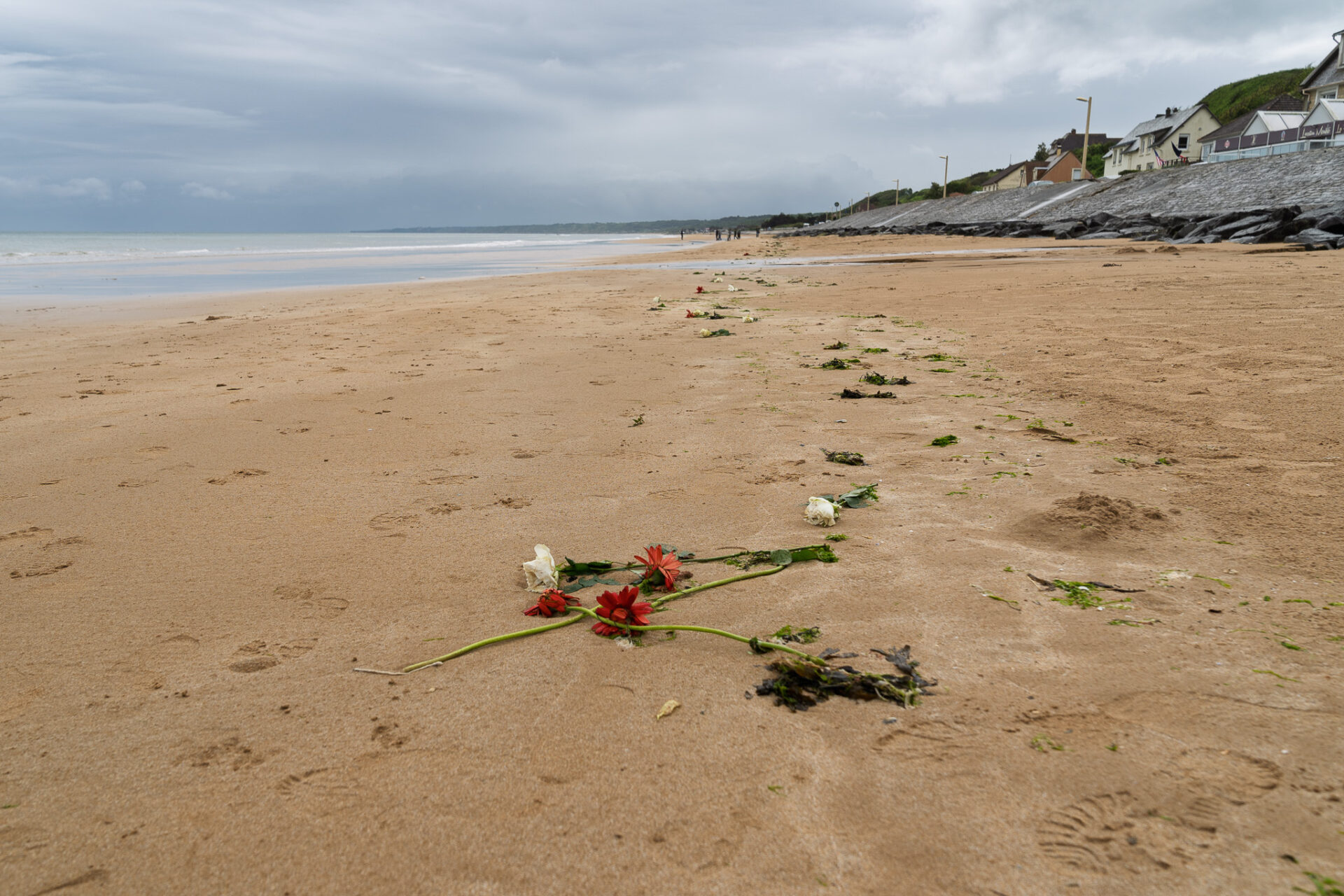
Each year on the anniversary of D-Day, people scatter flowers along the Normandy beaches to honor the Troops who landed there on June 6, 1944. This story captures the Herculean efforts of those who fought that day and provides a glimpse of the celebrations, tombstones, and ceremonies that honor them with lasting gratitude and love.

Utah and Omaha Beaches: The American Landings
Beginning at Utah Beach, we followed in the footsteps of Easy Company, 506th Regiment, 101st Airborne. You remember Easy Company from Stephen Ambrose’s acclaimed book and the HBO miniseries Band of Brothers, which brought the epic story to life. The 712-mile stretch—now called (Voie de la Liberté), The Liberty Road—outlines the path of the U.S. and Allies who landed on the beaches of Normandy on June 6, 1944 (Operation Overlord). From there, after overcoming unfathomable hardship at the landings, they continued onward, liberating towns and villages from German occupation.
D-Day Guide Mathias Leclerc illustrated the D-Day landings in the sand. In a synchronized effort, at 6:30 a.m., the 4th Infantry Division landed 23,250 troops on Utah Beach, and the 1st and 29th Infantry Divisions landed 34,250 troops on Omaha Beach. Under deadly crossfire from German positions located high above on the cliffs, troops jumped from the landing craft amid obstacles and mines. The Germans unleashed a deadly crossfire of 100,000 rounds per minute.
The troops at Utah Beach suffered 589 casualties; those at Omaha suffered 3,686 casualties, leading to its grim moniker ‘Bloody Omaha.’ The 475th Anti-Aircraft Artillery Automatic Weapons Battalion was among the troops who landed at Omaha Beach. Signage in the German Bunker (WN65) memorializes their sacrifices.


The Germans held an extensive network of fortified positions along Europe’s coasts and as far north as Scandinavia, collectively known as the Atlantic Wall.
Countless monuments along the beaches and in the towns express remembrance and gratitude for the heroic actions at Utah and Omaha Beaches. In 2024, a new memorial honors the U.S. Naval Combat Demolition Units (NCDUs) and Scouts and Raiders (S&Rs) for their heroic actions. They cleared the beaches of mines and other obstacles at the cost of many lives. In 2025, officials unveiled a new monument honoring the U.S. 8th Air Force and 47,000 airmen who lost their lives during the war.
The National Guard Monument at Omaha Beach is built atop the original German Bunker (WN72), which houses an 88 mm cannon. It’s the place where the 29th National Guard Division broke through German defenses on D-Day.
The monuments were pristine and adorned with beautiful wreaths of poppies on the Anniversary of D-Day.
Upon realizing his troops had landed off course at Utah Beach, Commander, Brigadier General Theodore Roosevelt, Jr. famously declared, “We’ll start the war from right here.”


225 Rangers from the 2nd Ranger Battalion heroically scaled the 100-foot cliffs at Pointe du Hoc with ladders and grappling hooks to take out machine gun nests and slow the carnage below.
The Rangers succeeded in neutralizing five of the six guns on their objective. The cost in lives was tremendous—77 killed, 152 wounded, and 38 missing.* The Overlord Museum holds the only surviving grappling hook, a treasured possession. The Point du Hoc Ranger Monument overlooks Omaha Beach. To honor the Rangers, the French erected the granite pylon on top of a German bunker and inscribed the names of the Rangers inside.


Sainte-Mère-Église
We had lunch with friends at a cozy, family-owned restaurant. The owners welcomed us with such genuine, heartfelt kindness that we felt as if we were having lunch at home with family.
Multiple museum pavilions at the Airborne Museum in the village of Saint-Mère-Eglise showcase the 82nd and 101st Airborne Divisions, with amazingly lifelike depictions. One Display vividly depicts the shock on the Germans’ faces as they watched hundreds of paratroopers descend from the sky. We anxiously anticipated seeing the effigy of paratrooper Private John Marvin Steele hanging from the church steeple—a powerful reminder of his dramatic landing. After hanging for two hours, the Germans captured him, whereupon he escaped and returned to help liberate the town.
After the war, Steele returned to Sainte-Mère-Église every year, where townspeople greeted him as an honored hero.

Sainte-Mère-Église 
Flags Flying on the Anniversary of D-Day at Sainte-Mère-Église 
Effigy of Pvt. John Steele hanging on the pinnacle at Notre-Dame-de-l’Assomption church 
Paratrooper and German display at the Airborne Museum 
Liberation Monument a memorial to the 82nd and 101st Airborne Divisions 
Lunch at Sainte-Mère-Église
Gold, Juno, and Sword Beaches: The British Commonwealth Landings
An hour after the U.S. landings, between 7:30 a.m. and 8:00 a.m., the Allies began landings at Gold, Juno, and Sword Beaches. The British 50th Division landed 25,000 troops on Gold Beach, and the 3rd Infantry Division landed 28,845 on Sword Beach, together suffering 3,027 casualties. The Canadian 3rd Infantry Division landed 21,400 on Juno Beach, with 1,242 deaths. The 6th British Airborne landed 8,000 paratroopers to secure the eastern flank and had 1,300 casualties.*


Pagusus Bridge
On the night of 5 to June 6, the British 6th Airborne Division set out to capture two key bridges and secure the eastern flank of the Normandy invasion. Against all odds, they quietly landed their troop-carrying Airspeed Horsa gliders in German-held territory. The stealthy operation would hinder a German counterattack. Scottish bagpiper William Millin (Piper Bill) inspired a story that became legend.
Wearing a kilt, Millen played the bagpipes as his Battalion marched across Pegasus Bridge under enemy fire.


Arromanches-les-Bains
German forces controlled all port facilities on D-Day, hindering the Allied supply line. To overcome this obstacle, British engineers secretly built an artificial port in just six months, using innovative technology. Under the German bunkers and machine-gun nests on the cliffs, they towed the fabricated port across the English Channel. Undetected, they anchored the port, called Mulberry B, at the coastal commune of Arromanches.
The floating harbor supplied Operation Overlord with 2.5 million men, 500,000 vehicles, and over 4 million tons of materiel within 10 months.* Today, Arromanches proudly honors its role with monuments, a museum featuring a scaled replica of Mulberry B., and remnants of the actual artificial port that wash closer to its shore each year.


A favorite memorial at Arromanches is the D-Day 75 Garden. Four figures, made from thousands of metal washers, represent D-Day soldiers wading through the waves and obstacles at Gold Beach. The image of D-Day veteran Bill Pendall, MM, is carved from a single piece of stone. With a pensive expression, he touchingly contemplates the young man’s image of himself as he wades ashore.
Reenactors took pictures at the D-Day 75 Garden, and the scenes looked as jovial as they might have looked in 1944, after the liberation.


Normandy American Cemetery
The Normandy American Cemetery is fittingly situated high above the cliffs overlooking Omaha Beach and the English Channel. The Commemorative Ceremony at the cemetery is the highlight of the D-Day Anniversary tour. About 2000 visitors attended the 81st anniversary of D-Day, including 25 WWII Veterans honored on stage. A grave and momentous occasion, it includes the Laying of Wreaths, Firing of Volleys & Taps, and Addresses praising the heroic actions of the Troops. From where we sat, I could barely make out the Veterans on stage, but after the ceremony, they welcomed visitors with humble smiles and handshakes.
The graceful monument at the Normandy American Cemetery is aptly titled “Spirit of American Youth Rising from the Waves.”


Overlord Museum
Convoys of vintage WWII vehicles passed by as we traveled by coach from one spot to the next. When we arrived at the Overlord Museum, we found a large Display of equipment and uniformed reenactors gathered outside. The atmosphere was festive, and it was the best place to ask questions. The reenactors were happy to share details about the D-Day events and the equipment on Display.
The Overlord Museum displays equipment, memorabilia, and amazingly authentic-looking displays. One Display that caught my eye was the one on the French Resistance at work. Incredibly, these brave individuals, it said, operated 89 networks at the risk of capture and sure death. Alas, the Germans captured and deported 3095, executed 2333, and the remainder,1056, died in camps.
‘My staff calculated that the actions of the resistance are equal to 15 divisions.’ – Supreme Commander General Dwight D. Eisenhower’s statement on the Display at the Overlord Museum.


Luxembourg American Cemetery
Gilded laurel wreaths, the ancient symbol of valor, sit atop the wrought-iron entrance gate to the Luxembourg American Cemetery. At his request, General Patton is among the 5,074 troops buried at the cemetery. There, after the sound of Taps, in a moving moment, the veterans in our group placed a wreath before the chapel.
The ceremonial playing of Taps and the Laying of Wreaths are among the most hallowed commemorative activities. They are prominent on the anniversary of D-Day.


Bastogne, Belgium
The final marker on Liberty Road, Kilometer 1147, stands near the Bastogne War Museum—a powerful reminder of the Battle of the Bulge. Here, the 101st Airborne, 10th Armored Division, and others endured brutal cold and relentless siege, huddled in foxholes as German forces closed in. Against all odds, they held their ground until Patton’s Division broke through and provided relief. But before this happened, convinced of their victory, the German command demanded that the Americans surrender—only to be famously refused, a moment that became a symbol of Allied resolve.
After sending a formal surrender ultimatum, Brigadier General McAuliffe sent back in a single word: “NUTS!”
That retort became the moniker for the 101st’s headquarters and lives on today on t-shirts and memorabilia. Each year, during the Anniversary of D-Day, the Mayor of Bastogne, with WWII veterans as honored guests, throws packages of nuts from the balcony of the mayor’s office. Meanwhile, indentations in the wooded ground outside town bear a haunting, silent witness to the hardships the troops endured there in 1944.
The story of Pvt. Vincent Speranza became a legend! Upon finding no water for his wounded comrade, he brought him a steel helmet filled with beer from a damaged tavern. Today, visitors can find locally crafted ‘Airborne’ beer in the local taverns and gift sets that include the beer with a ceramic helmet mug in the gift shops.

NUT! Bastogne War Rooms 
Bois Jacques Foxholes 101st Easy Company near Bastogne, Belgium 
Bastogne Airborne Beer with a Helmet Cup 
Screaming Eagle statue at the Mardasson Memorial in Bastogne, Belgium 
Peace Woods trees planted in honor of WWII veterans spell the UNICEF emblam visible from the air. 
Last Liberty Road Marker 1147 KM in Bastogne, Belgium
Alas, our journey down The Liberty Road drew to a close.
We left with a deeper understanding and sense of gratitude for these historic events.
The Troops who plunged into the water, cleared the mines, climbed the cliffs, parachuted behind enemy lines, flew the bombers and gliders, and sabotaged the enemy fought courageously, sacrificing everything.
The American Battle Monuments Commission, the Commonwealth War Graves Commission, local authorities, and numerous associations created these memorials. Thousands of people visit them each year. The flowers and ceremonies—these are acts that keep the memory of these courageous heroes alive. These tributes and the outpouring of love and gratitude on the Anniversary of D-Day stand as enduring reminders of sacrifice, resilience, and the unbreakable bonds forged in war.


Nancy Smith and Dan Brown, on the right, are pictured with Eddie at the Normandy American Cemetery. Nancy is a member of the all-volunteer Abraham Lincoln National Cemetery Memorial Squad, assisting the DOD in providing military honors for all veterans. She volunteers with the Honor Guard in Chicago for Honor Flights and at Military funerals. She has escorted 4 Veterans to Washington, D.C.
Dan is a percussionist who performs with the Frankfort Brass Band. They provide patriotic tunes for all guests awaiting the arrival of veterans who have participated in the Chicago Honor Flight’ Day of Honor’.
Eddie and I are grateful to Nancy and Dan for inspiring us to take this unforgettable journey. As you can see in the picture, they are a joy!
The photo of me at the Kehlsteinhaus in Germany marks the close of our D-Day anniversary celebration.
Travel Notes:
The Beaches of Normandy D-Day Anniversary Tour provides a unique learning experience. The places below are added in these notes for their significance in Easy Company’s experiences or in our own journey.
Dachau Concentration Camp Memorial Site
During WWII, Easy Company came upon and liberated one of the eleven subcamps of Dachau, the Kaufering camp. Our journey took us to Dachau, the memorial site. Here, we found a few long, sorrowful barracks, fences (minus the electricity), and the crematorium ovens. They tell a somber story. The designers of crematorium ovens in the camps, H. Kori and Topf & Söhne, used innovative designs for the efficiency of mass murder. Interestingly, however, signage at Dachau, Memorial Site explains that this was not a camp with ovens used to dispose of the bodies of people who died in the camps, and not for the bodies of mass killings using poison gas.
‘The number of prisoners incarcerated in Dachau between 1933 and 1945 exceeded 200,000. Scholars believe that at least 40,000 prisoners died there.’ ~ The Holocaust Encyclopedia
Exhibitions at Dachau inform visitors of the history of the camp, as well as the chilling brutality and horror. Painter and graphic artist David Ludwig Bloch was imprisoned for four weeks at Dachau, was released, and, in 1940, escaped to Shanghai, where he painted a scene of prisoners standing in formation for daily headcount. The legend said that sometimes they stood for as long as 22 hours.
The painting depicts the scene in a way that my mind could not fathom; each speck represents a person.
Sculptor Nandor Glid’s International Monument confronts viewers with exaggerated figures tangled in an electrified barbed wire fence. Opposite it is a sculpture of colored triangular patches that represent those sewn onto the prisoners’ clothing. Banded together in the sculpture, the patches represent the prisoners’ solidarity even in the face of unimaginable horror.


Le Cambe German War Cemetery
The narrow entry to the Le Cambe German War Cemetery allows each person to enter alone for a personal reflection and to focus attention on the cemetery. Black basalt ornamental crosses are strikingly different from the white crosses and Stars of David markers in the American cemeteries. ‘The site represented grief and defeat, but, at the same time, eternal peace, too.’ – Beaches of Normandy Tours.
Two grieving figures stand atop the tumulus (Comrades’ Grave); underneath is the mass grave of 296 German Soldiers.


Kehlsteinhaus
Finally, we visited the place where the troops of Easy Company parted ways, Kehlsteinhaus. Hitler’s ‘Eagles Nest,’ as they called it, the mountaintop retreat in Berchtesgaden. Today, it functions as a restaurant, with stunning views.

*This story uses numbers and casualty figures from the Beaches of Normandy Tours handout, “D-Day, June 6, 1944,” and from the D-Day Fact Sheet by the National WWII Museum. Please note that these figures are only approximations.
D-Day Fact Sheet – National WWII Museum.
Eddie and I were fortunate to serve in the South Carolina National Guard with Brig. Gen. Buford Mabry, whose parents, Buford Stuckey Mabry, Sr., and Eugenia Mabry, both served during WWII. It’s an endearing love story, told by them in the documentary South Carolina’s Greatest Generation. See them and more of South Carolina’s WWII heroes at the link below.
South Carolina’s Greatest Generation
More fascinating military stories on Travel Notes and Storytelling.
“The Best Company” at the S.C. Military History Foundation
Women from S.C. inspire future generations with their remarkable military service.